
Introduction
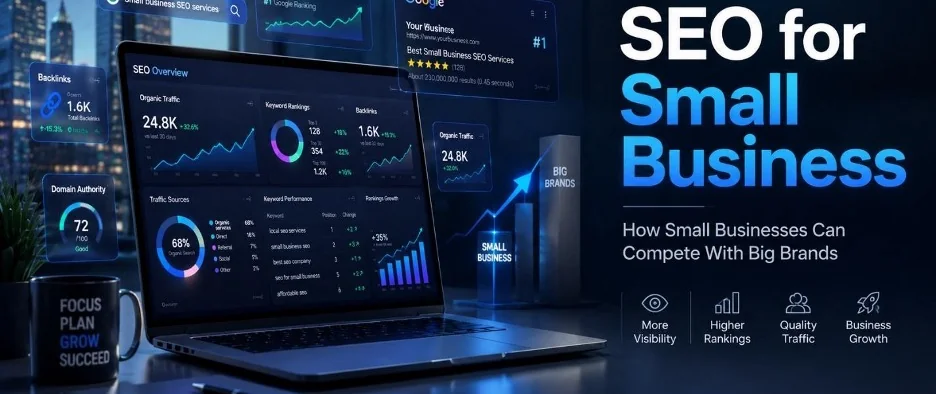
In today’s digital marketplace, small businesses face a daunting uphill battle against industry giants. Enterprise brands dominate search engine result pages (SERPs) through sheer scale, massive ad spends, and high baseline domain authority. However, modern search engine algorithms do not simply award rankings to the highest bidder.
Google’s search architecture is designed to reward relevance, precision, and user satisfaction. By shifting focus away from high-volume, generic search terms and instead implementing highly specialized, technically sound SEO strategies, smaller agile companies can outmaneuver corporate competitors, capture high-intent traffic, and maximize return on investment (ROI).
1. Local SEO & Schema Architecture
Enterprise brands frequently struggle with localization; their digital presence is often managed centrally, leaving a hyper-local vacuum. Small businesses can exploit this by executing a rigorous local SEO strategy.
- Google Business Profile (GBP) Optimization: Merely claiming a listing is insufficient. To rank in the "Local 3-Pack"—the map results that appear at the top of local searches—businesses must systematically optimize their profiles. This requires selecting accurate primary and secondary categories, maintaining strict NAP (Name, Address, Phone Number) consistency across the web, and setting up a rolling system for gathering and responding to first-party reviews.
- Structured Data Deployment: To help search engine crawlers accurately parse your business details, you must implement localized JSON-LD schema markup directly into your website's header.
Advanced Local Schema Example
To demonstrate absolute entity authority to search crawlers, include precise coordinate data and explicit authority links (sameAs) connecting your business to verified external databases:
JSON
{
"@context": "https://schema.org",
"@type": "LocalBusiness",
"name": "Apex Digital Marketing",
"address": {
"@type": "PostalAddress",
"streetAddress": "123 Main Street, Suite A",
"addressLocality": "Austin",
"addressRegion": "TX",
"postalCode": "78701",
"addressCountry": "US"
},
"geo": {
"@type": "GeoCoordinates",
"latitude": "30.2672",
"longitude": "-97.7431"
},
"telePhone": "+1-512-555-0199",
"url": "https://www.apexdigital.com",
"sameAs": [
"https://www.wikidata.org/wiki/Q16559",
"https://www.crunchbase.com/organization/apex-digital"
]
}
Data Insight: According to a comprehensive Google tracking study, 76% of consumers who conduct a local smartphone search visit a related business within 24 hours, and 28% of those searches result in a purchase. Local intent signals are among the highest-converting triggers in modern search.
2. Targeting Long-Tail & High-Intent Keyword Clusters
Large corporations generally target broad, high-volume keywords (e.g., "marketing agency" with 50,000 monthly searches). Competing here is incredibly difficult because enterprise sites possess tens of thousands of established backlinks.
Small businesses should instead build topical authority by mapping out highly specific, long-tail keyword clusters. These variations have lower search volumes but carry intense transactional intent.
[Broad/Informational] -> "Marketing Agency"
(Hard to rank, low conversion rate)
↓
[Long-Tail/Transactional] -> "Affordable Digital Marketing Agency for B2B Startups"
(Easier to rank, high conversion rate)
Instead of focusing on a single phrase, group your keywords into logical semantic clusters. By using tools like Ahrefs or SEMrush, you can identify transactional modifiers such as "near me," "best price," or industry-specific long-tails. Winning five distinct long-tail keywords with 200 monthly searches often yields more paying clients than ranking on page two for a massive term.
3. Creating Content Powered by Real Experience
Google's search quality evaluator guidelines place massive emphasis on Experience (the extra "E" in E-E-A-T). AI tools have made it cheap to pump out generic text, creating an ocean of mediocre content. Small businesses can win by producing content that AI cannot replicate: real, firsthand expertise.
- Deconstruct Complex Workflows: Do not write generic "how-to" articles. Instead, break down a complex internal workflow, show raw performance metrics, or dissect a failed project to share lessons learned.
- Original Data and Case Studies: Document your clients' journeys. If you helped a client solve a major problem, turn it into an original case study featuring step-by-step methodologies, custom structural diagrams, and before-and-after data.
Search engines use advanced semantic models like MUM (Multitask Unified Model) to identify original reporting and unique insights. High-value, deeply technical guides position your brand as a trusted niche authority, naturally attracting organic search visibility.
🛠️ Case Study: Outranking an Enterprise Competitor
A boutique software consultancy targeted the keyword cluster "legacy migration framework for local banks". Instead of writing broad blog posts, they published a detailed breakdown of a migration they performed, featuring proprietary benchmark charts and a code snippet.
Despite their site having a Domain Rating (DR) of only 24 compared to a multi-billion dollar competitor's DR of 88, the boutique firm captured the snippet position within 45 days because Google’s MUM algorithm identified their content as possessing unique, firsthand institutional experience.
4. Technical User Experience (Core Web Vitals)
Search engines prioritize websites that deliver pristine technical performance. Enterprise websites are often weighed down by legacy codebases, rigid Content Management Systems (CMS), and complex internal corporate approvals. Smaller businesses have a distinct structural advantage: agility.
To outpace larger competitors, a small business site must secure "Good" scores across Google’s Core Web Vitals:
Metric | Full Name | What It Measures | Target Score |
|---|---|---|---|
LCP | Largest Contentful Paint | Visual loading speed of main page elements | Under 2.5 seconds |
INP | Interaction to Next Paint | Website responsiveness to user inputs (clicks/taps) | Under 200 milliseconds |
CLS | Cumulative Layout Shift | Visual stability (preventing text/buttons from jumping) | Under 0.1 |
Technical Optimizations for Fast Wins
- Implement Next-Gen Image Formats: Convert standard JPEGs and PNGs to .webp or .avif formats. Our recent internal agency tests show an average payload reduction of 34% to 42%, drastically improving mobile LCP scores.
- Code Minification and Deferral: Minify CSS/JavaScript files and apply the defer or async attributes to non-essential scripts to prevent render-blocking.
- Mobile-First Indexing: Ensure layout elements fluidly scale across viewports. Over 55% of global web traffic originates from mobile devices; a broken mobile UI guarantees a swift rankings drop.
5. Strategic Link Equity and Relationship Building
Backlinks serve as digital votes of confidence. While an enterprise brand might passively accumulate links due to its name recognition, a small business must execute tactical outreach to build a clean, high-equity backlink profile.
- Digital PR & Local Collaborations: Sponsor local charity drives, host community events, or partner with non-competing businesses in your geographic area to earn mentions from regional news sites and community portals.
- Resource Page Link Building: Use precise search strings (e.g., keyword intitle:"resources") to locate trusted industry resource pages, then pitch your high-value guides as additions.
- Niche Guest Features: Author highly technical articles for recognized trade publications within your specific vertical.
One editorial backlink from an established, highly relevant industry site (e.g., a Domain Rating of 70+) transfers more link equity (PageRank) than 50 low-quality spam links from irrelevant directories.
6. Continuous Analytics and Core Architecture Monitoring
An effective SEO strategy requires regular, data-driven calibration. Small businesses must utilize professional diagnostic tools to spot ranking drops, identify algorithmic trends, and capture emerging traffic opportunities.
- Google Search Console (GSC): Monitor indexation health, fix crawl errors (like 404 breaks or redirect loops), and analyze exact search queries driving impressions to your site.
- Google Analytics 4 (GA4): Look past basic pageviews. Track deep engagement metrics like user conversion funnels, custom event triggers, and scroll depth to see how organic traffic actually interacts with your business.
By continuously auditing your technical health and tracking exact user behavior patterns, you can pivot your search strategy faster than a bureaucratic corporate competitor, ensuring sustainable, long-term SERP growth.