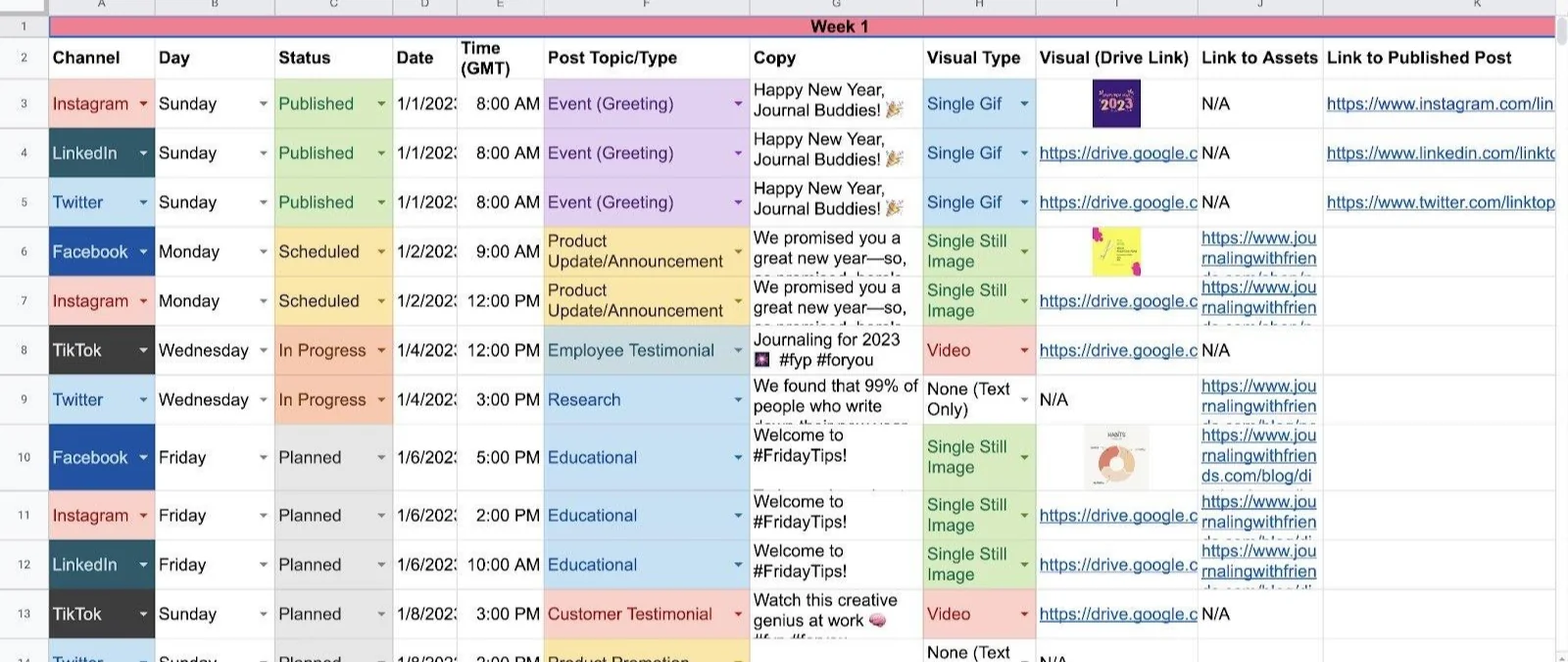

A content calendar is a foundational governance tool for digital marketing. Without a centralized framework, teams suffer from operational friction: missed deadlines, redundant topics, and ad-hoc creation that fails to drive revenue. According to the Content Marketing Institute, 80% of the most successful B2B marketers use a documented content strategy, with a structured editorial calendar serving as its operational engine.
By transitioning to a data-driven content calendar, you can institutionalize workflows, scale production without sacrificing quality, and tie every piece of creative output to measurable business KPIs.
The Strategic Foundation: Objective-Led Planning
An effective content calendar doesn't just track publishing dates; it maps production to specific stages of the marketing funnel. To establish institutional alignment, every asset must be categorized by its primary business goal and its corresponding Funnel Position:
Funnel Stage | Content Format Examples | Primary KPI | Target Metrics |
|---|---|---|---|
TOFU (Top of Funnel) | SEO Blog Posts, Short-form Video | Brand Awareness | Organic Traffic, Backlinks, Impressions |
MOFU (Middle of Funnel) | Gated Whitepapers, Webinars, Templates | Lead Generation | MQLs (Marketing Qualified Leads), CTR |
BOFU (Bottom of Funnel) | Case Studies, Product Walkthroughs | Conversion | Pipeline Velocity, Customer Acquisition |
Anatomy of an Enterprise Content Calendar Template
To prevent operational bottlenecks, your tracking environment—whether built in Airtable, Notion, Trello or custom project management tools—must go beyond simple "Title" and "Date" fields. A production-ready architecture requires these exact metadata fields:
- Production Status (Conditional Pipeline): Ideation $\rightarrow$ Briefing $\rightarrow$ Drafting $\rightarrow$ Review/Legal $\rightarrow$ Scheduled $\rightarrow$ Live.
- The Content Pillar: The broader thematic category (e.g., Technical SEO, Conversion Rate Optimization).
- SEO Target Profile: Primary keyword, search volume, and explicit search intent (Informational, Navigational, Commercial, or Transactional).
- Distribution Matrix: A list of secondary channels where the asset will be cross-promoted (e.g., LinkedIn, Email Newsletter, YouTube Shorts).
- RACI Assignment: Explicit roles designating who is Responsible (writer), Accountable (editor/content manager), Consulted (subject matter expert), and Informed (PR/Social team).
Structuring Content Pillars and Seasonal Anchors
Avoid "random acts of content" by anchoring your calendar around Content Pillars—the core thematic categories that reflect your brand’s competitive advantage.
The 70/20/10 Distribution Rule
To maintain balanced authority, structure your monthly editorial mix using a proven resource allocation framework:
- 70% Core Pillars (Core Expertise): Evergreen, high-utility foundational content (e.g., "Step-by-Step Guide to Data Analytics").
- 20% Seasonal/Cultural Anchors: Product launches, major industry events (e.g., INBOUND or CES), and seasonal macro-trends.
- 10% High-Risk/Experimental: Testing new formats, opinion pieces, or leveraging breaking news (newsjacking).
The "Hub-and-Spoke" Execution Example
To maximize authority on a topic, design your calendar around a Hub-and-Spoke (Topic Cluster) model.
Real-World Application: If your core pillar is Remote Team Management, your "Hub" is an exhaustive, 4,000-word comprehensive guide. Your "Spokes" are smaller, targeted assets built sequentially into your calendar: "Top 10 Video Conferencing Tools," "How to Manage Asynchronous Time Zones," and a downloadable "Remote Onboarding Checklist." This signals deep topical authority to both users and search engine crawlers.
Advanced Workflows: The Content Repurposing Engine
Publishing a single blog post and moving on is an inefficient use of resources. Advanced content operations treat every major asset as a "source molecule" to be broken down into cross-channel derivatives.
When scheduling a major asset, build its downstream derivatives directly into the calendar workflow:
[Core Asset: 45-Minute Long-Form Webinar]
│
├──► Spoke 1: 3x SEO-Optimized Blog Posts (Transcribed & Polished)
│
├──► Spoke 2: 5x Vertical Video Clips (TikTok / YouTube Shorts / Reels)
│
└──► Spoke 3: 1x Comprehensive Email Newsletter Sequence
By mapping this repurposing pipeline directly inside your template, you guarantee that a single creative investment generates weeks of multi-channel touchpoints.
Technical SEO Integration & Content Optimization
Every digital content calendar must explicitly integrate search engine optimization from the briefing stage. Do not treat SEO as a post-writing polish. Before a writer begins, the calendar entry must compile:
- Primary Search Intent Match: If the primary keyword is "best CRM software," the intent is commercial comparison. The calendar should mandate a listicle format, not a conceptual essay.
- Inbound Tracking Architecture: Pre-define the exact clean URL slug and generate UTM tracking parameters for distribution channels to prevent downstream analytics fragmentation.
- Internal Link Mapping: Specify exactly 3 to 5 existing internal URLs that the new piece must link back to, alongside 2 high-authority external references to establish immediate contextual relevance.
Governance, Agility, and Performance Iteration
A content calendar is a living document, not a rigid prison. While it should project out 30 to 60 days for predictable production, it must feature built-in "buffer slots" to account for shifting market realities.
Managing Algorithm and Market Pivots
Allocate one open slot bi-weekly for reactive content. If a sudden industry shift occurs—such as a major core search algorithm update or a competitor announcement—the content manager can activate the buffer slot, shifting planned evergreen content down the timeline without breaking dependencies.
The Feedback Loop
At the close of every month, audit your calendar against your baseline traffic and lead attribution metrics. If your data reveals that video case studies are converting at a 4.2% higher rate than written whitepapers, your content calendar must adapt. Use these performance reviews to dynamically adjust your upcoming content mix, ensuring that your operational calendar continuously optimizes for maximum return on investment (ROI).